Nesavu · The Weave
How a Handloom Saree Is Made
From yarn to finished saree — the six stages of a handloom weave.
Kaithari ·Handloom, not Powerloom
Every saree in our catalogue is woven by hand.
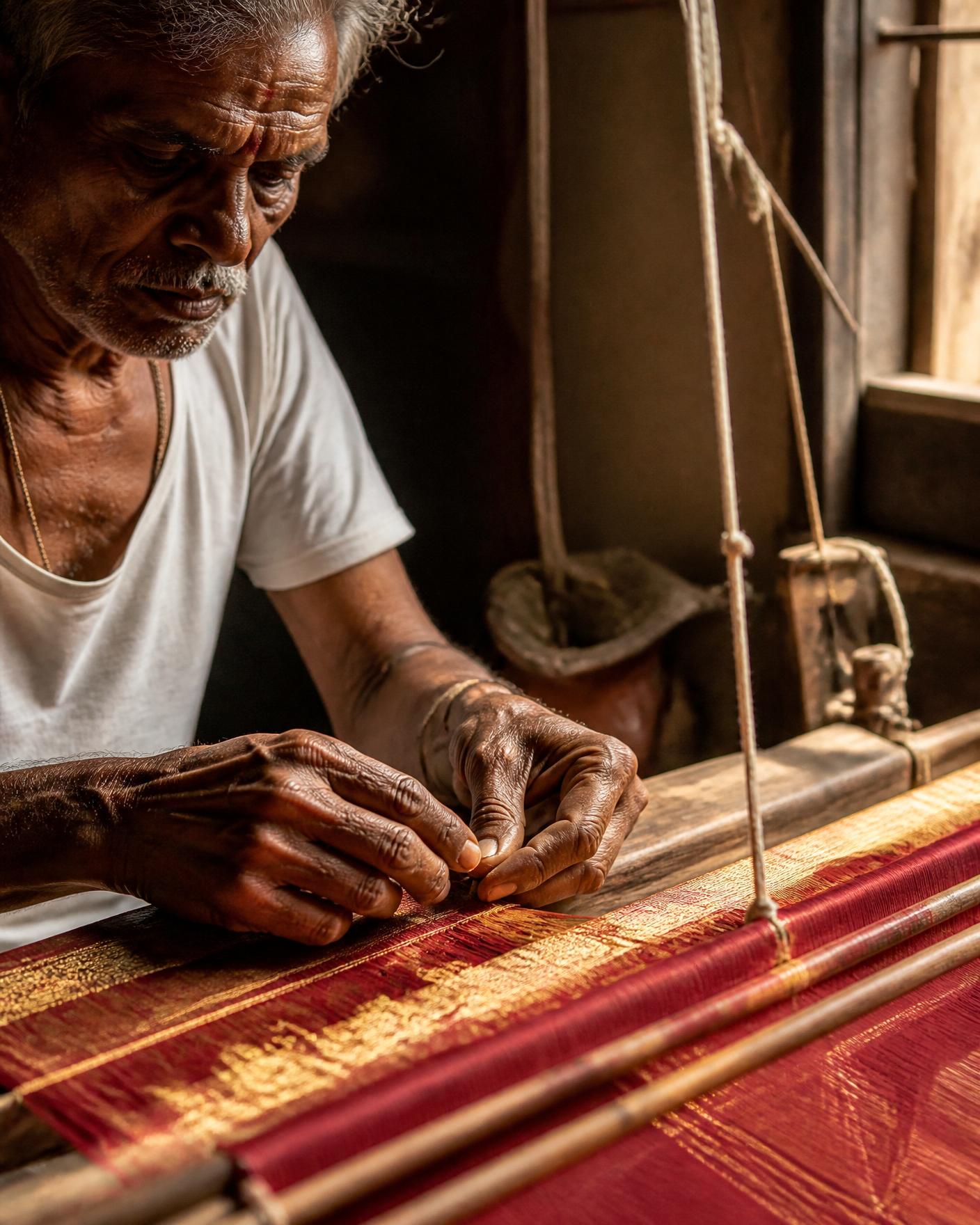
A handloom saree is woven on a wooden or pit loom, one shuttle at a time, by a single weaver (or a small team for wider or more complex weaves). It is the opposite of a powerloom saree, where a mechanised loom produces many identical sarees quickly. Handloom is slower, more expensive, and — in the fabric itself — visibly different.
01
Nool
The yarn
Cotton (or silk-cotton) yarn is sourced from spinning mills in the weaving region. For coloured sarees, the yarn is dyed at this stage — in vats, by hand, with colour-fast dyes.
02
Naadi
Warping
Thousands of yarn threads are drawn taut along the length of the loom to form the warp. A single saree's warp can take a full day of careful measurement and tensioning.
03
Karai
The border setup
For weaves with a contrast border — Kanchipuram, Chettinad, Maheshwari — the border yarn is set up separately, either as a joined korvai border or as an integrated part of the warp.
04
Nesavu
Weaving
The weft is thrown by hand across the warp, one pass at a time. For butta or extra-weft motif sarees, additional weft threads are inserted at each motif position and cut close to the fabric.
05
Pallu
The pallu
The end of the saree — the pallu — is woven with the most attention. Motifs are denser, the border is often more elaborate, and the weave may slow to accommodate the design.
06
Mudivu
Finishing
The finished saree is cut from the loom, washed to remove sizing, blocked to shape, folded, and inspected. A handloom saree typically rests for several days before it ships.
Nēram ·How Long a Saree Takes
Approximate weaving time by weave
Chettinad cotton
10 – 14 days
Kanchipuram cotton
12 – 20 days
Maheshwari silk-cotton
18 – 25 days
Pochampally silk-cotton (ikat)
20 – 35 days
Madurai Sungudi (tie-dye)
14 – 20 days
Cotton handloom butta
15 – 22 days
Rich Pallu Kanchi cotton
20 – 30 days
Ranges are typical for a single saree by a single skilled weaver. Complex borders, extra-weft motifs and pallu detailing add time.
Kaithari Kandupidi ·How to Identify a Handloom Saree
Four quick checks
- 1. Check the reverse. A handloom looks nearly identical on the back. A powerloom often has a rougher reverse with more thread ends.
- 2. Look for slight irregularity. Handloom means human — check spacing, motif alignment, and colour saturation vary slightly. These are marks of authenticity.
- 3. Feel the border. On a korvai border, the join between border and body is a fine, unbroken interlock — no long threads.
- 4. Ask for the weaving cluster. A real handloom seller can name the village or region. GI-tagged weaves come with a GI label.